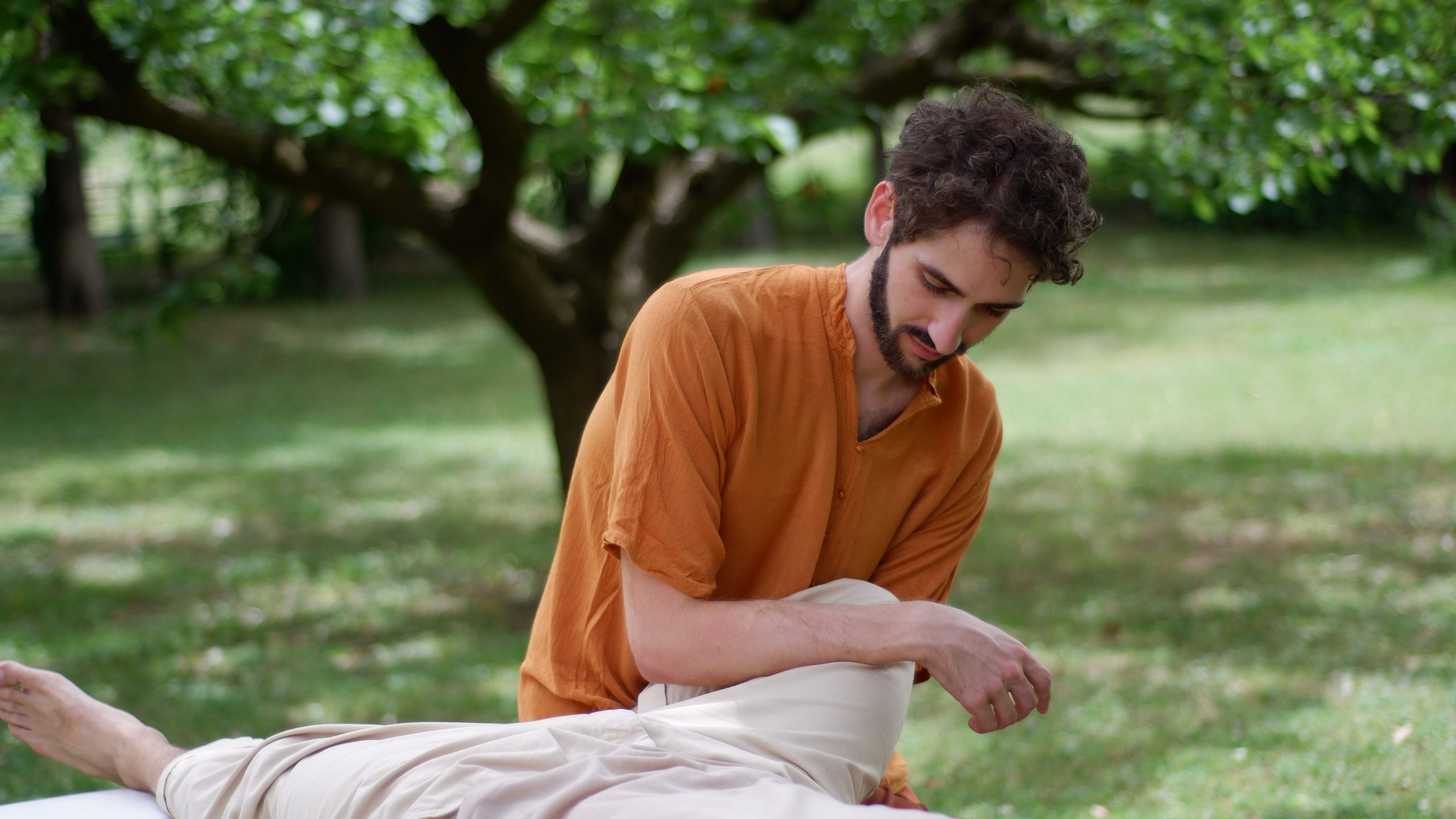
Somatic Experiencing: Healing from Trauma
Somatic Experiencing is a powerful and innovative therapeutic approach for healing from trauma, integrating body, mind, and emotions. This method is distinguished by its ability to modulate pain, both acute and chronic, through practices of body awareness and breathing techniques. Patients are guided to explore the bodily sensations associated with pain, learning how to recognize and differentiate nociceptive pain, caused by tissue damage, from somatic pain, derived from muscle tension and stress. This learning process allows patients to release accumulated tensions in the body, leading to a significant reduction in the perception of pain.
Parasympathetic Activation
A central aspect of Somatic Experiencing is the activation of the parasympathetic nervous system, responsible for relaxation and recovery from stress. This activation not only helps to decrease anxiety and tension, but also promotes physical and psychological healing, allowing the body to free itself from traumatic charges trapped in the nervous system. The understanding of Peter Levine’s notions regarding the three brains (the reptilian brain, the limbic system, and the cerebral cortex) are fundamental in this context. So it is important to say that at the center of this practice is the understanding of the triune brain (Paul Donald MacLean), a model that describes our brain as composed of three main structures, each with distinct functions and evolutionary origins.
The Triune Brain:
- Reptilian Brain: The oldest part of our brain, is the guardian of our vital functions and instinctive survival responses. In situations perceived as dangerous, the reptilian brain triggers the fight-or-flight reaction, or, if the situation is perceived as inescapable, the response is immobilization. In trauma, the reptilian brain can remain stuck in a state of hypervigilance, continuously activating defense mechanisms, even in the absence of a real danger. Somatic Experiencing works to calm this primitive brain, helping the individual to recognize and release accumulated somatic tensions.
- Limbic System: The emotional brain, is the center of our emotions, memories, and affective bonds. Trauma can create real scars at the level of the limbic system, generating intense and dysfunctional emotions, such as fear, anger, or sadness, which can reactivate even after a long time. Somatic Experiencing offers tools to process these blocked emotions, helping the individual to find a sense of security and connection with himself and others.
- Neocortex: The newest part, is responsible for higher cognitive functions, such as rational thinking, planning, and creativity. In trauma, the neocortex can be overwhelmed by the intense emotions and reactions of the reptilian brain and the limbic system, limiting the ability to understand and manage the experience. Somatic Experiencing helps to restore a balance between the different parts of the brain, allowing the neocortex to resume its role as director and to integrate traumatic experiences into a more cohesive narrative.
Internal Resources & Techniques
The recognition of positive qualities, such as resilience and creativity, can further strengthen self-confidence. Positive connections with family and friends provide a sense of belonging and support, essential for emotional well-being. Furthermore, taking care of oneself through physical exercise, a healthy diet, and relaxation techniques promotes physical and mental well-being conducive to managing difficulties. To activate these internal resources, Somatic Experiencing uses various techniques, including visualization exercises and positive affirmations, which can strengthen confidence and the ability to face challenges. Mindfulness practices help to cultivate greater body awareness, while mindful movement and diaphragmatic breathing promote a deep connection with the body and facilitate the release of accumulated tensions.
Effectiveness & Personal Growth
The effectiveness of Somatic Experiencing is based on defined mechanisms of action, including the activation of the parasympathetic nervous system and the improvement of emotional regulation. Through this integrated approach, patients face pain more effectively and embark on a healing path that leads to a more meaningful life. Somatic Experiencing not only alleviates pain but transforms the experience of trauma into an opportunity for personal growth and resilience. This approach not only addresses pain and its physical manifestations, but is proposed as a path of discovery and activation of internal resources. This allows patients to rediscover their inner strength, promoting a more meaningful life, enriched by greater self-awareness and positive connections with others.

Somatic for PTSD
Interoception and Proprioception in Somatic Experiencing
In the article “Somatic Experiencing: using interoception and proprioception as core elements of trauma therapy” by Payne, the authors discuss the importance of interoception and proprioception in trauma treatment through S.E.
This therapy focuses on awareness of internal bodily sensations and spatial perceptions, crucial for recovering from traumatic experiences.2 In a subsequent correction, the authors acknowledge overlooking studies supporting Somatic Experiencing’s effectiveness. They highlight articles describing successful cases and outcome studies demonstrating benefits in trauma contexts, such as survivors of natural disasters and military personnel. S.E. can be an effective early intervention for alleviating trauma symptoms, with promising results in patients who experienced traumatic events like the earthquake in China or the 2004 tsunami. The results suggest that the S.E. approach, integrating body awareness practices, can improve resilience and reduce post-traumatic symptoms. This article highlights the importance of body awareness in improving psychological and physical well-being, emphasizing the relevance of integrating somatic practices in massage therapy for deeper trauma therapy.
Payne Peter , Levine Peter A. , Crane-Godreau Mardi A. Corrigendum: Somatic Experiencing: using
interoception and proprioception as core elements of trauma therapy, Frontiers in Psychology VOL 6, 2015
https://www.frontiersin.org/journals/psychology/articles/10.3389/fpsyg.2015.00423
doi: 10.3389/fpsyg.2015.00423
Effectiveness and Key Factors of S.E.
In the article “Somatic experiencing – effectiveness and key factors of a body-oriented trauma therapy: a scoping literature review” by Kuhfuß, a review of the literature on the effectiveness of S.E. is presented. The authors highlight how S.E. focuses on filling a gap in trauma treatments and is gaining increasing interest in both research and therapy. The review included 83 articles, of which 16 were systematically analyzed. Preliminary results suggest positive effects of Somatic Experiencing on PTSD-related symptoms, as well as a positive impact on affective and somatic symptoms and overall well-being, in both traumatized and non-traumatized samples. Among the key factors specific to the method, practitioners and patients identified resource orientation and the use of physical contact as fundamental elements of S.E.
Kuhfuß, M., Maldei, T., Hetmanek, A., & Baumann, N. (2021). Somatic experiencing – effectiveness and
key factors of a body-oriented trauma therapy: a scoping literature review. European Journal of
Psychotraumatology, 12(1). https://doi.org/10.1080/20008198.2021.1929023 Full article: Somatic
experiencing – effectiveness and key factors of a body-oriented trauma therapy: a scoping literature review
(tandfonline.com)
S.E. for Chronic Back Pain and PTSD
A randomized clinical trial by Andersen on patients with chronic back pain and post-traumatic stress disorder (PTSD) showed that adding Somatic Experiencing to standard treatment led to a significant reduction in PTSD symptoms and fear of movement. This suggests that S.E. can be an effective approach to manage the comorbidity between chronic pain and trauma.
Andersen TE, Ellegaard H, Schiøttz-Christensen B, Manniche C. Somatic experiencing® for patients with
low back pain and comorbid posttraumatic stress disorder – protocol of a randomized controlled trial. BMC
Complement Altern Med. 2018 Nov 22;18(1):308. doi: 10.1186/s12906-018-2370-y. PMID: 30466429;
PMCID: PMC6251218. https://pubmed.ncbi.nlm.nih.gov/28680540/
S.E. for Transgender Individuals with Fibromyalgia-like Experiences
A study by Briggs on transgender individuals with experiences similar to those of patients with fibromyalgia showed that Somatic Experiencing led to significant improvements in somatic symptoms, including pain and fatigue, as well as a reduction in depressive symptoms.
Briggs PC, Hayes S, Changaris M. Somatic Experiencing® Informed Therapeutic Group for the Care and
Treatment of Biopsychosocial Effects upon a Gender Diverse Identity. Front Psychiatry. 2018 Feb 27;9:53.
doi: 10.3389/fpsyt.2018.00053. PMID: 29535648; PMCID: PMC5835108.
https://pubmed.ncbi.nlm.nih.gov/29535648/
S.E. for Women with Breast Cancer
A study conducted by Vagnini showed how Somatic Experiencing can promote significant improvements in body image and the ability to face the future in women who have suffered from breast cancer, in addition to reducing psychological symptoms.
Vagnini D, Grassi MM, Saita E. Evaluating Somatic Experiencing® to Heal Cancer Trauma: First
Evidence with Breast Cancer Survivors. Int J Environ Res Public Health. 2023 Jul 20;20(14):6412. doi:
10.3390/ijerph20146412. PMID: 37510644; PMCID: PMC10380079.
https://pubmed.ncbi.nlm.nih.gov/37510644/
S.E. for Veterans with PTSD
Brom and colleagues demonstrated the effectiveness of Somatic Experiencing in significantly reducing symptoms of post-traumatic stress disorder (PTSD) in a sample of veterans, offering a new perspective for the treatment of complex traumas.
Brom, D., Stokar, Y., Lawi, C., Nuriel-Porat, V., Ziv, Y., Lerner, K. and Ross, G. (2017), Somatic
Experiencing for Posttraumatic Stress Disorder: A Randomized Controlled Outcome Study. JOURNAL OF
TRAUMATIC STRESS, 30: 304-312. https://doi.org/10.1002/jts.22189
S.E. for Homeless Individuals with GAD
An investigation by Changaris on homeless individuals with generalized anxiety disorder (GAD) showed that the application of Somatic Experiencing led to a significant decrease in anxious symptoms, greatly improving the psychological well-being of the participants.
Published by ProQuest LLC (2013) ASSESSING THE EFFICACY OF SOMATIC EXPERIENCING FOR
REDUCING SYMPTOMS OF ANXIETY AND DEPRESSSION, Michael C. Changaris, MAY 17th, 2010
https://www.proquest.com/openview/e3fb8cd78cf6ef538699291adb2262ec/1?pqorigsite=gscholar&cbl=18750
S.E. for Mental Health Professionals
An investigation by Winblad on mental health professionals who followed a path in Somatic Experiencing highlighted a significant improvement in quality of life and a reduction in anxious and somatic symptoms. These results suggest that S.E., promoting resilience and emotional regulation, could also be effective in reducing the frequency and intensity of panic attacks in patients with panic disorder.
Winblad NE, Changaris M and Stein PK (2018) Effect of Somatic Experiencing Resiliency-Based Trauma
Treatment Training on Quality of Life and Psychological Health as Potential Markers of Resilience in
Treating Professionals. Front. Neurosci. 12:70. doi: 10.3389/fnins.2018.00070
https://www.frontiersin.org/journals/neuroscience/articles/10.3389/fnins.2018.00070/full