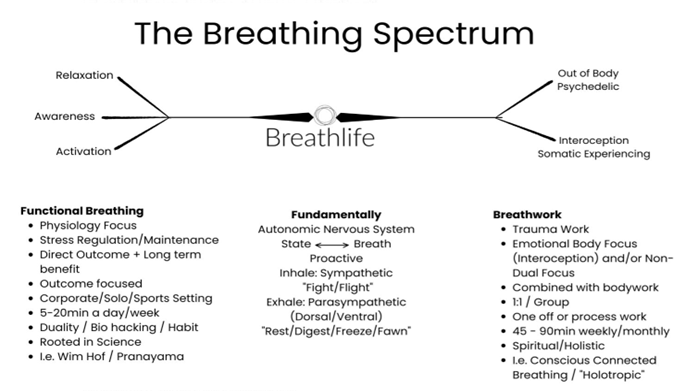
Breath Awareness in Action
Breath Connection
The connection between scientific data, body awareness, and complementary therapies reveals itself as an extraordinary key to unlock the potential of self-healing and achieve deep well-being. Today, research highlights how these elements interact in surprising ways, positively influencing our physical and mental health.
Vital Process
Breathing, in particular, emerges as a vital process that transcends mere physiological function. Diaphragmatic breathing, by activating the parasympathetic nervous system, plays a crucial role in reducing stress and optimizing the supply of oxygen to tissues, thus promoting relaxation and a feeling of well-being. This type of breathing not only calms the mind but also invites us to get in touch with bodily sensations, allowing us to explore our inner selves with greater awareness.
Essential Awareness
In this context, body awareness becomes essential, as it allows us to pay attention to physical sensations in the present moment and to recognize tensions and areas of discomfort. Like a muscle, this sensitivity can be trained through practices such as meditation, tai chi, and yoga, which develop an increasingly deep connection with our body, learning to respond consciously to its needs.
Tangible Benefits
The combination of diaphragmatic breathing with careful awareness of bodily sensations offers a series of tangible benefits. It promotes a significant reduction in anxiety and stress, helping to improve sleep quality, making it more restorative. Furthermore, this practice enhances our resilience, providing effective tools to face daily challenges and strengthening the immune system through an adequate supply of oxygen.
Journey Discovery
In this journey of discovery, body awareness guides us to notice muscle tensions and areas of discomfort, allowing us to concentrate diaphragmatic breathing on these areas to release accumulated tension. By paying attention to the rhythm, depth, and quality of breathing, we can identify any imbalances and make the necessary changes to optimize our breathing experience.
Impartial Observers
When we pay attention to our bodily sensations and our emotions without judgment, we become impartial observers of our internal experience. This practice allows us to distance ourselves from patterns of thought and automatic reactions, often rooted in past experiences. By observing our emotions with curiosity, rather than reacting to them impulsively, we acquire the ability to choose our responses instead of being victims of them. This process of self-observation not only promotes self-understanding but also fosters greater inner calm that allows us to live a more authentic and satisfying life.
Body Influence
Body awareness, integrated with active listening and breathing, plays a fundamental role in positively influencing various physiological systems and promoting overall well-being. These elements interact synergistically to improve the functioning of the nervous system, the endocrine system, and the immune system.
Active Listening
Active listening fosters the ability to manage emotions and daily difficulties, making individuals stronger in the face of adversity. Furthermore, these practices not only promote relaxation but also contribute to maintaining a hormonal balance. By regulating the production of stress hormones, such as cortisol, better mental health is promoted and chronic inflammation is reduced, an important risk factor for many diseases.
Immune System
The combination of active listening practices exerts a positive effect on the immune system, strengthening the body’s ability to fight infections and reducing the risk of developing chronic diseases, such as cancer and cardiovascular diseases. Similarly, active listening is crucial for building healthy and meaningful relationships, as it promotes effective communication and fosters empathy. Learning to listen to one’s emotions allows one to understand them better and manage them more effectively. In this context, breathing proves to be a crucial element for physical and mental well-being.
Combined Tools
By combining these tools, a useful approach can be promoted in the daily routine that can lead to more effective physical healing, an improvement in mental health, and greater self-awareness, increasing the ability to face daily challenges. It is fundamental to recognize that this approach is not limited to adding the benefits of each element, but is based on the interaction between them, creating a deep and lasting change in overall well-being.
Study Results
In the study by Busch, entitled “The Effect of Deep and Slow Breathing on Pain Perception, Autonomic Activity, and Mood Processing,” the impact of deep and slow breathing (DSB) techniques on pain perception, autonomic activity, and mood processing is examined. The results show that DSB techniques, particularly when practiced in a relaxation context, can lead to a significant increase in pain and thermal detection thresholds, suggesting a decrease in pain sensitivity. On the other hand, a DSB associated with an attention task did not show significant effects on pain perception, highlighting how relaxation is a crucial element to modulate sympathetic activity. Furthermore, deep and slow breathing led to a reduction in negative feelings such as tension, anger, and depression, underlining the importance of breathing techniques in managing psychophysical well-being.
These results support the idea that the integration of body awareness through breathing practices can constitute an effective therapeutic approach to alleviate pain and improve mood, making these techniques particularly relevant in the practice of massage therapy and in the management of chronic pain.
Volker Busch, Walter Magerl, Uwe Kern, Joachim Haas, Göran Hajak, Peter Eichhammer, The Effect of
Deep and Slow Breathing on Pain Perception, Autonomic Activity, and Mood Processing—An Experimental
Study, Pain Medicine, Volume 13, Issue 2, February 2012, Pages 215
228,https://academic.oup.com/painmedicine/article/13/2/215/1936333?searchresult=1